Our Products
Three Products. Every One of Them With an Established Industrial Market.
Pyrolysis does not produce waste streams. Every output from our reactor has a buyer. Plastic pyrolysis oil goes to industrial fuel markets. Pyrolytic carbon black goes to rubber, paint, construction, and asphalt applications. Pyrolysis gas fuels the reactor itself. That closed-loop recovery is part of what makes pyrolysis viable as a plastic recycling method at commercial scale.
Our feedstock includes a range of plastic types. Polyolefins such as PP, LDPE, HDPE, and LLDPE are well-represented in our processing because they produce consistently high oil yields and their thermal degradation behaviour is predictable. They also happen to be among the highest-volume plastic waste categories generated globally, which means there is no shortage of feedstock when the process is running well.

Plastic Pyrolysis Oil
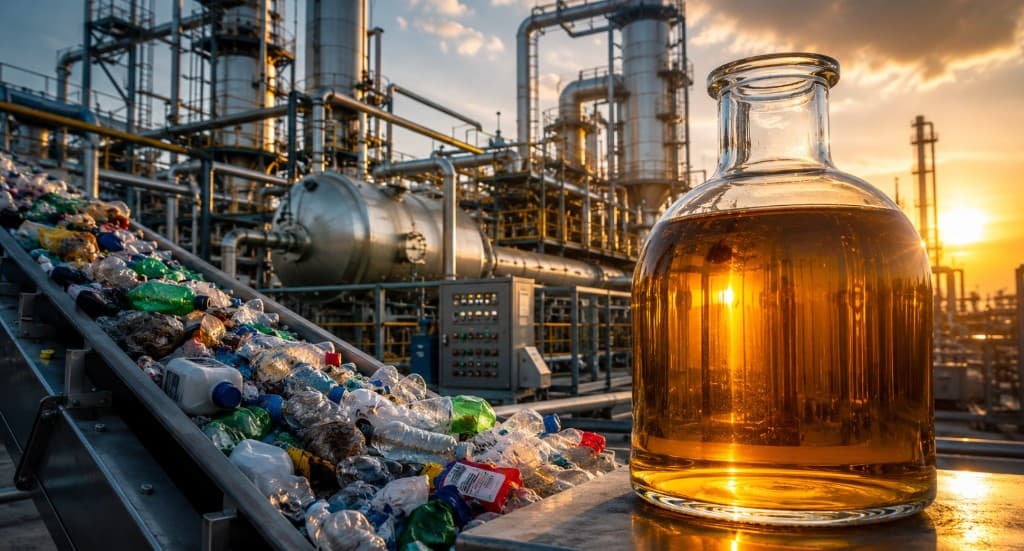
When plastic feedstock depolymerises in the reactor, it produces hydrocarbon vapours. Those vapours pass through the condensation system and liquefy into pyrolysis oil. The quality and yield of that oil depends on feedstock composition, reactor temperature, and how well the condensation system is operating. Get those right and you produce an oil with a calorific value that sits close to conventional furnace oil and diesel.
That matters because it determines where the oil can be used. Industrial boiler operators, ceramic kiln operators, glass manufacturers, steel plant furnace managers, and generator operators all use fuel oil in their processes. Plastic-derived pyrolysis oil works in those applications as a direct substitute. In many cases, it requires no significant modification to existing burner equipment. The industrial market for pyrolysis oil is active and growing as more operations look to reduce their dependence on fossil-derived fuel inputs.
Features
- High calorific value, comparable to conventional furnace oil
- Produced from compatible plastic feedstock including polyolefin streams
- Recovered through vapour condensation in the pyrolysis system
- Proven substitute for fossil-derived industrial fuel oil
- Active buyer market across multiple industrial combustion sectors
- Reduces industrial dependence on virgin petroleum-derived fuel
Applications
- Industrial Boilers and Steam Generation Systems
- Ceramic and Tile Manufacturing Kilns
- Glass Melting and Manufacturing Furnaces
- Steel Plant and Foundry Furnace Fuel
- Brick and Lime Kiln Operations
- Industrial Generator and Power Sets
- Shipping and Marine Fuel Applications
- General Industrial Process Heating
Pyrolytic Carbon Black
During depolymerisation, the volatile components in the plastic feedstock vaporise and leave the reactor as gas. The carbon content stays behind in the reactor as a dark, fine-particle solid. That is pyrolytic carbon black, or PCB. It comes out after each reactor cycle, gets processed to improve consistency, and goes into industrial markets that have used carbon black as a functional material for decades.
The applications are well-established. In rubber compounding, carbon black functions as a reinforcing filler, improving tensile strength, abrasion resistance, and the durability of finished rubber products. In paint and pigment manufacturing it provides strong black pigmentation with good lightfastness. In asphalt modification it acts as a filler and performance enhancer. In plastic masterbatch production it serves as a colouring and UV-stabilising agent. Pyrolytic carbon black produced from plastic pyrolysis carries these same functional properties. Virgin carbon black is produced from the incomplete combustion of fossil fuels. Pyrolytic carbon black recovered from plastic waste is the more environmentally sound alternative, and the markets that use it know the difference.
Features
- Solid carbon residue recovered directly from the pyrolysis reactor
- Fine dark particle form with functional carbon black characteristics
- Produced without combustion, preserving carbon material integrity
- Post-processed after discharge for consistent particle output
- Drop-in material for rubber, paint, construction, and asphalt markets
- Environmentally preferable to virgin fossil-derived carbon black
Applications
- Rubber Compounding and Tyre Component Manufacturing
- Paint, Coating, and Industrial Pigment Formulation
- Plastic Masterbatch and Colouring Production
- Asphalt Modification and Road Surface Manufacturing
- Construction Material Filler and Additive
- Ink and Printing Application Pigments
- UV Stabilisation in Plastic Product Manufacturing
- General Industrial Carbon Filler Use
Pyrolysis Gas
A portion of the vapour stream produced in the reactor remains in gas phase after passing through the condensation system. This is non-condensable gas, or NCG. It is made up of short-chain hydrocarbons including methane, ethane, propane, and butane. All of them burn.
Instead of venting or flaring that gas, we capture it and route it to the reactor burner as process fuel. It is a simple idea but an important one. The energy content of the NCG stream directly offsets the external fuel input needed to keep the reactor at operating temperature. In a facility that is processing consistently, that gas recovery has a meaningful effect on operating costs per tonne. It also means the pyrolysis cycle is partially self-sustaining energetically, which is the right way to run it.
Features
- Non-condensable hydrocarbon gas stream from the pyrolysis reactor
- Short-chain combustible hydrocarbons recovered from the vapour stream
- Captured and used as fuel for the reactor burner system
- Reduces external energy input and plant fuel costs
- Improves overall energy efficiency of the pyrolysis operation
- Contributes to the closed-loop energy balance across each processing cycle
Applications
- Reactor Burner Fuel to Sustain Continuous Pyrolysis Operation
- On-Site Process Heat Generation
- Energy Cost Reduction in Plastic Waste Processing
- Thermal Efficiency Improvement in Pyrolysis Plant Operations
Product Quality in Pyrolysis Starts Long Before the Reactor
The quality of what comes out is decided mostly by what goes in and how the process is managed, not by what you do at the end. Feedstock type directly affects oil composition. Moisture content in incoming material affects reactor stability. Temperature control during depolymerisation determines the product distribution between oil, gas, and char. Condensation system performance determines how much of the vapour stream is recovered as liquid oil. Every one of these variables is managed deliberately at Moh Renewable because every one of them shows up in the final product.
At Moh Renewable, feedstock assessment and pre-treatment are taken seriously before anything enters the reactor. Reactor conditions are managed to defined operating parameters throughout each cycle. The condensation system is maintained to capture oil yield efficiently. Carbon black is processed after discharge to produce consistent particle output.
What goes out as a product from our facility has been through a process that was managed with that outcome in mind from the beginning.
Enquire About Supply or Processing
For pyrolysis oil or carbon black supply, or to discuss a plastic waste processing arrangement, contact our team and we will get back to you with relevant and accurate information.